
Introduction
In the world of industrial materials, colour is far more than a cosmetic choice—it's a critical indicator of performance, durability, and intended application. Nowhere is this more evident than in the distinction between grey and white UPVC (Unplasticised Polyvinyl Chloride).
While both materials share the same base polymer, their formulations, performance characteristics, and suitable applications couldn't be more different. White UPVC dominates residential plumbing and indoor applications, while grey UPVC is the undisputed standard for industrial, outdoor, and high-performance environments.
But why does colour matter so much? And why do industrial applications overwhelmingly demand the grey standard? This comprehensive guide answers these questions and provides the technical insights you need to make the right material choice for your project.
Material Composition: Same Base, Different Additives
The fundamental chemical structure of PVC resin is identical in both white and grey UPVC products. The difference in colour—and the resulting performance variations—stems from specific additives incorporated during the compounding process.
White UPVC Composition
White UPVC achieves its bright colour through titanium dioxide (TiO₂) pigment—a white particulate filler added to the PVC matrix. This pigment serves primarily as a colourant and provides limited UV protection by reflecting and scattering light.
Grey UPVC Composition
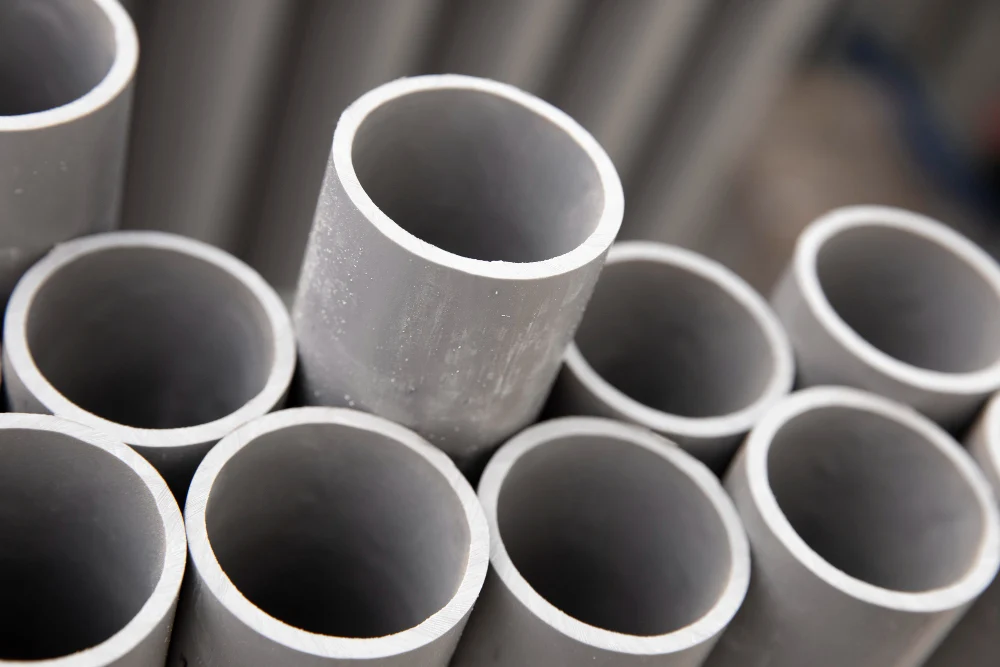
Grey UPVC, particularly conduit and industrial grade piping, contains carbon black—a highly effective UV absorber and stabilizer. Carbon black is typically added in proportions of 2.5% to 4.5% to ensure durable UV resistance.
UV Resistance: The Decisive Difference
Why UV Resistance Matters
UPVC exposed to sunlight without adequate UV protection undergoes photodegradation—the polymer chains break down, causing the material to become brittle, discoloured, and structurally compromised.
White UPVC: Limited Protection
White UPVC uses titanium dioxide for UV protection, but this provides only surface-level protection that diminishes if scratched or over time. Chemical UV absorbers in white PVC degrade with prolonged exposure.
Real-world testing reveals the dramatic difference:
| Exposure Condition | White UPVC Performance | Grey UPVC Performance |
|---|---|---|
| Direct sunlight (1 year) | Becomes brittle, discolours | Maintains flexibility and strength |
| Intermittent outdoor use | 2–3 year lifespan | 10+ year lifespan |
| Buried/indoor applications | Excellent performance | Excellent performance |
Grey UPVC: Superior UV Protection
Carbon black in grey UPVC absorbs harmful UV radiation and converts it into low-level heat, preventing damage to the polymer chains. This protection is:
- Uniform throughout the material—not just surface-level
- Continuous even if the surface is scratched
- Effective for decades of outdoor exposure
Mechanical Properties: Strength Under Pressure
Tensile Strength
Scientific studies have demonstrated that grey PVC pipes have tensile strength greater than white PVC pipes under identical test conditions.
Research published in Materials Sciences and Applications tested both materials across various strain rates, temperatures, and UV exposure conditions. The findings consistently showed that grey PVC exhibits superior tensile strength compared to white PVC.
The yield stress and modulus of elasticity were found to be directly proportional to strain rate and inversely proportional to treatment temperature for both materials—but grey PVC consistently outperformed white PVC across all parameters.
Long-Term Weathering Performance
Observations of white and grey UPVC weathered outdoors for periods of up to 11 years reveal significant differences:
- Exposed surfaces of both materials chalk after 2–3 years
- Tensile strength at break of white UPVC decreases moderately over time
- Tensile strength at break of grey UPVC does not change significantly
This long-term data confirms that grey UPVC maintains its mechanical integrity far longer than white UPVC in outdoor environments.
Wall Thickness and Pressure Ratings
The colour difference often correlates with Schedule ratings:
| Characteristic | White UPVC | Grey UPVC |
|---|---|---|
| Typical Schedule | Schedule 40 | Schedule 80 |
| Wall Thickness | Thinner | Thicker |
| Pressure Rating | Lower | Higher |
Schedule 80 grey UPVC is manufactured with a significantly thicker wall than common white Schedule 40 pipe, allowing it to safely handle substantially higher internal pressure.
Applications: Built for Different Worlds
White UPVC Applications
White UPVC is overwhelmingly associated with plumbing applications:
- Potable water systems under pressure
- Drainage, waste, and vent (DWV) systems
- Residential and commercial non-pressure or low-pressure fluid transport
- General water supply lines
White UPVC conforms to standards like ASTM D2665 and is commonly manufactured in Schedule 40 wall thickness.
Grey UPVC Applications
Grey UPVC serves completely different purposes:
Electrical Conduit
- Provides protective pathways for electrical wires and cables
- UV-resistant and suitable for prolonged outdoor exposure
- Rigid structure offers stability and protection
- Ideal for underground, indoor, and outdoor installations
Industrial Pressure Piping
- Schedule 80 grey PVC for high-pressure industrial applications
- Chemical processing plants handling acids, alkalis, and corrosive fluids
- Water treatment facilities
- Agriculture and irrigation systems
Industrial Sheets and Profiles
- Chemical processing and mechanical engineering
- Tank building and protective barriers
- Ductwork and ventilation systems
Standard Grey Shades
- RAL 7011 (Iron Grey) – Most common for industrial piping, sheets, and profiles
- RAL 7016 (Anthracite Grey) – Architectural profiles, window frames
- RAL 7038 (Agate Grey) – Lighter grey for interior industrial applications
The Color Coding System: Why Standardization Matters
PVC pipes are manufactured in different colours to provide immediate visual identification of their intended application, material composition, and performance capabilities.
This color standardization allows:
- Warehouse personnel to quickly sort and stock materials
- Installers to grab correct pipes without reading small print
- Inspectors to verify compliance visually from a distance
- Maintenance teams to identify systems during repairs
Cost Considerations: Short-Term vs. Long-Term Value
Initial Cost
White UPVC is generally less expensive than grey UPVC due to simpler formulation and lower additive costs. This makes it attractive for residential and indoor applications where UV resistance isn't required.
Long-Term Value
However, for outdoor and industrial applications, grey UPVC offers superior long-term value:
- 10+ year lifespan in outdoor applications vs. 2–3 years for white UPVC
- No degradation of tensile strength over decades of exposure
- Minimal maintenance—no painting, no corrosion treatment
- No replacement costs from premature failure
Total Cost of Ownership
| Factor | White UPVC (Outdoor) | Grey UPVC (Outdoor) |
|---|---|---|
| Initial material cost | Lower | Higher |
| Replacement frequency | Every 2–3 years | 10+ years |
| Maintenance costs | Higher | Minimal |
| Long-term cost | Higher | Lower |
When specifying materials for industrial applications, the total cost of ownership—not just the initial purchase price—should drive the decision.
When to Specify Grey UPVC
✅ Choose Grey UPVC For:
- All outdoor installations exposed to sunlight
- Electrical conduit above or below ground
- High-pressure industrial piping (Schedule 80)
- Chemical processing and corrosive fluid handling
- Industrial sheets and profiles for fabrication
- Any application requiring UV resistance and long-term durability
- Projects where failure would be costly or dangerous
✅ Choose White UPVC For:
- Indoor plumbing and potable water systems
- Drainage, waste, and vent systems
- Residential and commercial applications not exposed to sunlight
- Buried applications (though grey can also be used)
- Short-term or temporary installations
❌ Never Use:
- White UPVC for outdoor electrical conduit—it lacks UV protection and is not code-compliant
- Grey electrical conduit for plumbing—it is not pressure-tested for liquids
- White UPVC for high-pressure industrial applications—it lacks the wall thickness and strength
Industry Standards and Compliance
Key Standards for Grey UPVC
| Standard | Description |
|---|---|
| ASTM D1784 | Rigid PVC compounds classification |
| ASTM D2466 | PVC socket-type fittings |
| DIN 8061/8062 | German standards for PVC-U pipes and fittings |
| EN ISO 1452 | European standard for PVC-U piping systems |
| IS 4985 | Indian standard for uPVC pipes |
| NEMA | Electrical conduit standards |
Lead-Free Certification
Modern industrial grade grey UPVC . is manufactured lead-free, making it safe for potable water and food-contact applications. This is a critical requirement for pharmaceutical, food processing, and drinking water systems.
Conclusion
The distinction between grey and white UPVC is not merely aesthetic—it's a fundamental difference in material formulation, performance, and intended application.
Key Takeaways
- Grey UPVC contains carbon black for superior UV protection; white UPVC uses titanium dioxide for limited protection
- Grey UPVC has greater tensile strength than white UPVC under identical test conditions
- Grey UPVC lasts 10+ years outdoors; white UPVC degrades in 2–3 years
- Grey UPVC is the standard for electrical conduit, industrial pressure piping, and outdoor applications
- White UPVC is the standard for indoor plumbing, DWV systems, and residential applications
- Schedule 80 grey UPVC handles substantially higher pressures than white Schedule 40
- Colour coding prevents dangerous misapplications—never substitute one for the other
The Final Word
When your application demands durability, UV resistance, high pressure tolerance, and long-term reliability, the choice is clear: industrial applications demand the grey standard.
White UPVC has its place—in residential plumbing and indoor environments where UV exposure isn't a concern. But for industrial, outdoor, and high-performance applications, grey UPVC is not just a recommendation—it's a requirement.
Ready to Make the Right Material Choice?
Our team of industrial piping specialists can help you select the perfect UPVC grade for your application.
📞 Call +91 99623 26944