
⭐ Quick Answer: What Defines Industrial Grade Grey UPVC?
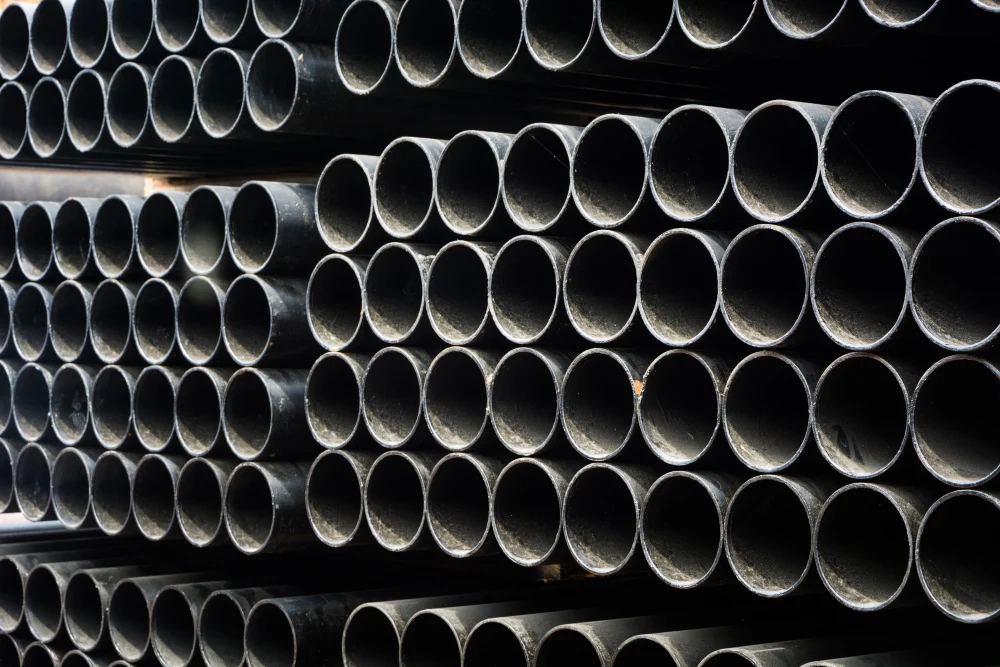
Industrial grade grey UPVC is an unplasticised (rigid) PVC compound pigmented with carbon black for through-thickness UV protection. It typically delivers 49–52 MPa tensile strength, a 0°C to 60°C long-term service range, excellent resistance to dilute acids, alkalis, salts and oils, high dielectric strength, and a self-extinguishing UL94 V0 fire rating — manufactured to ASTM D1784 Cell Class 12454-B and equivalent international standards.
Pressure piping, chemical processing lines, electrical conduit, industrial sheets/profiles
Aromatic/chlorinated hydrocarbons, strong oxidisers, sustained service above 70°C
Table of Contents
- Introduction
- Material Science — The Chemistry Behind UPVC
- Physical Properties
- Mechanical Properties
- Thermal Properties
- Chemical Resistance
- Electrical Properties
- Flame Retardance and Fire Safety
- Standards and Specifications
- Performance Data in Real-World Conditions
- Summary of Key Technical Specifications
- Conclusion
Introduction
In the world of engineering materials, few substances offer the combination of strength, chemical resistance, and cost-effectiveness found in industrial grade grey UPVC (Unplasticised Polyvinyl Chloride). But beyond its visible grey colour and widespread use, what makes this material perform so reliably in demanding industrial environments?
This technical deep-dive explores the material science, chemical composition, physical properties, and performance data that define industrial grade grey UPVC. Drawing on international standards and verified test data, this guide is designed for engineers, specifiers, and technical professionals who need to understand exactly what this material can — and cannot — deliver.
Material Science: The Chemistry Behind UPVC
What is UPVC?
UPVC — also known as PVC-U or rigid PVC — is an amorphous commodity thermoplastic. Unlike plasticised PVC (which contains added plasticisers for flexibility), UPVC contains no plasticisers, making it inherently stiff, strong, and dimensionally stable.
The term "unplasticised" is critical: without plasticisers, the polymer chains remain tightly packed, resulting in:
- Higher mechanical strength
- Superior chemical resistance
- Better dimensional stability under load
- Greater resistance to creep and deformation
Polymer Structure
UPVC is produced through the polymerisation of vinyl chloride monomers (CH₂=CHCl). The resulting polymer consists of long chains of repeating -CH₂-CHCl- units. The chlorine atoms along the backbone contribute to:
- Flame retardance (chlorine is inherently flame-inhibiting)
- Chemical resistance (the polar C-Cl bond resists many solvents)
- Rigidity (steric hindrance from chlorine atoms restricts chain mobility)
Additives and Stabilisers
Pure UPVC is difficult to melt-process because it begins to decompose before it melts. This is why additives are essential:
| Additive Type | Function | Common Examples |
|---|---|---|
| Heat Stabilisers | Prevent thermal degradation during processing | Tin mercaptide, lead systems, Ca/Zn complexes, rare earth compounds |
| UV Stabilisers | Protect against photodegradation | Carbon black (imparts grey colour), titanium dioxide (white) |
| Impact Modifiers | Improve toughness and reduce brittleness | Acrylics, MBS, CPE |
| Lubricants | Enhance processability | Paraffin waxes, stearic acid |
| Pigments | Provide colour and UV protection | Carbon black (grey), titanium dioxide (white) |
Why Carbon Black Makes UPVC Grey
The distinctive grey colour of industrial UPVC comes from the addition of carbon black — a fine particulate form of elemental carbon. Carbon black serves a dual purpose:
- UV Absorption: Carbon black absorbs ultraviolet radiation and converts it to low-level heat, preventing polymer chain scission
- Pigmentation: Provides the characteristic grey colour (typically RAL 7011, 7016, or 7038)
Unlike white UPVC which relies on titanium dioxide for limited surface-level UV protection, grey UPVC with carbon black offers uniform, through-thickness UV protection that remains effective even if the surface is scratched.
Physical Properties
Density and Specific Gravity
Industrial grade grey UPVC typically exhibits a density of 1.41–1.45 g/cm³:
| Source | Density (g/cm³) | Test Standard |
|---|---|---|
| Prince Pipes (Schedule 80) | 1.43 ± 0.02 | ASTM D792 |
| Röchling Trovidur® ES grey | 1.41 | DIN EN ISO 1183-1 |
| Premium UPVC Grey Sheet (RAL 7011) | 1.44 | — |
| Typical UPVC | 1.4 | AZoM |
This density is approximately 1.5 times that of water and roughly one-fifth that of steel, making UPVC significantly lighter than metal alternatives while maintaining excellent strength.
Water Absorption
UPVC is highly resistant to moisture absorption:
| Source | Water Absorption | Test Standard |
|---|---|---|
| Röchling Trovidur® ES grey | 0.20% | DIN EN ISO 62 |
| Typical UPVC | 0.1% | — |
This low water absorption ensures dimensional stability in wet environments and prevents degradation from moisture ingress.
Mechanical Properties
Tensile Strength and Modulus
Tensile strength is a critical parameter for any material used in pressure applications. Industrial grade grey UPVC demonstrates tensile strengths ranging from 49 to 52 MPa:
| Source | Tensile Strength | Test Standard |
|---|---|---|
| Prince Pipes Easyfit iN | 49 MPa | ASTM D638 |
| AZoM (Typical UPVC) | 51 MPa | — |
| Premium UPVC Grey Sheet | 50 MPa (yield) | — |
| Röchling Trovidur® ES grey | 48 MPa (yield) | DIN EN ISO 527 |
The tensile modulus of elasticity (stiffness) typically ranges from 2.5 to 4 GPa. More specifically:
| Source | Tensile Modulus |
|---|---|
| Premium UPVC Grey Sheet | 3200 MPa |
| Röchling Trovidur® ES grey | 2500 MPa |
| AZoM (Flexural Modulus) | 3000 MPa |
Flexural Strength
Flexural strength measures a material's ability to resist deformation under load. Industrial grey UPVC demonstrates excellent flexural properties:
| Source | Flexural Strength | Test Standard |
|---|---|---|
| Prince Pipes Easyfit iN | 96.5 MPa | ASTM D790 |
| Röchling Trovidur® ES grey | 65 MPa | DIN EN ISO 178 |
The significant variation between sources reflects differences in formulation, impact modification, and testing methodology.
Impact Strength
Impact resistance is crucial for industrial applications where pipes and sheets may be subjected to accidental impacts or mechanical stress:
| Source | Impact Strength | Test Standard |
|---|---|---|
| Typical UPVC | 0.08 kJ/m (Notched Izod) | — |
| Röchling Trovidur® ES grey | 8 kJ/m² (Notched impact) | DIN EN ISO 179 |
| Premium UPVC Grey Sheet | 4 kJ/m² (Notched impact) | — |
| General UPVC range | 20–1000 J/m (Izod) | — |
Hardness
UPVC is a relatively hard thermoplastic:
| Source | Hardness | Test Standard |
|---|---|---|
| Typical UPVC | R106-120 (Rockwell) | — |
| Röchling Trovidur® ES grey | 80 (Shore D) | DIN EN ISO 868 |
| Premium UPVC Grey Sheet | 80 (Shore D) | — |
| AZoM | RR110 (Surface Hardness) | — |
Elongation and Ductility
Elongation at break indicates the material's ductility — how much it can stretch before failure:
| Source | Elongation at Break |
|---|---|
| Typical UPVC | 60% |
| Premium UPVC Grey Sheet | 15% |
| Röchling Trovidur® ES grey | 20% |
The wide variation reflects differences in impact modification. Standard UPVC can elongate up to 60%, while highly filled or impact-modified grades may exhibit lower elongation with higher toughness.
Compressive Strength
For applications involving compression loads:
| Source | Compressive Strength | Test Standard |
|---|---|---|
| Röchling Trovidur® ES grey | 65 MPa | DIN EN ISO 604 |
Thermal Properties
Service Temperature Range
Industrial grade grey UPVC has a limited but well-defined operating temperature range:
| Parameter | Value |
|---|---|
| Long-term service temperature | 0°C to 60°C |
| Short-term maximum service temperature | 70°C |
| Upper continuous use temperature | 50–60°C |
| Lower working temperature | −30°C |
| Minimum service temperature | −20°C |
Heat Deflection Temperature (HDT)
HDT indicates the temperature at which a material deforms under a specified load:
| Source | HDT (0.45 MPa) | HDT (1.80 MPa) | Test Standard |
|---|---|---|---|
| Prince Pipes Easyfit iN | 77°C | — | ASTM D648 |
| Röchling Trovidur® ES grey | 70°C | — | DIN EN ISO 75 |
| AZoM | 70°C | 67°C | — |
| Premium UPVC Grey Sheet | 60°C | — | — |
The variation reflects differences in formulation — higher-performance grades achieve higher HDT values.
Vicat Softening Temperature
Vicat temperature indicates the temperature at which a material begins to soften:
| Source | Vicat Softening Temperature | Test Standard |
|---|---|---|
| Röchling Trovidur® ES grey | 75°C | DIN EN ISO 306, Vicat B |
Thermal Conductivity
UPVC is a poor conductor of heat, which is advantageous for thermal insulation:
| Source | Thermal Conductivity |
|---|---|
| Prince Pipes Easyfit iN | 0.17 W/m/°K |
| Röchling Trovidur® ES grey | 0.16 W/(m·K) |
| Premium UPVC Grey Sheet | 0.2 W/(m·K) |
This low thermal conductivity means UPVC piping systems experience less heat loss or gain than metal piping, sustaining service temperatures more efficiently.
Coefficient of Linear Thermal Expansion (CLTE)
UPVC expands and contracts with temperature changes more than metals:
| Source | CLTE |
|---|---|
| Röchling Trovidur® ES grey | ~0.075 mm/m·K |
| Premium UPVC Grey Sheet | 80 × 10⁻⁶ K⁻¹ |
| AZoM | 6 × 10⁻⁵ /°C |
This relatively high thermal expansion (approximately 5–6 times that of steel) must be accommodated in piping system design through expansion loops and joints.
Chemical Resistance
Industrial grade grey UPVC offers excellent resistance to a wide range of chemicals, making it the material of choice for corrosive environments.
Chemical Resistance Profile
| Chemical Class | Resistance Rating | Notes |
|---|---|---|
| Acids — Dilute | Good | Resistant to most dilute mineral acids |
| Acids — Concentrated | Good–Poor | Depends on specific acid and concentration |
| Alcohols | Good | Resistant to most alcohols |
| Alkalis | Good | Excellent resistance to caustic solutions |
| Greases and Oils | Good | Suitable for most industrial oils and greases |
| Salt Solutions | Good | Resistant to saline and brine solutions |
| Aromatic Hydrocarbons | Poor | Not resistant — will cause swelling and degradation |
| Halogenated Hydrocarbons | Fair–Poor | Limited resistance |
| Halogens | Fair | Limited resistance |
| Ketones | Poor | Not resistant |
Key Chemical Resistance Features
- Acids and alkalis: UPVC's chemical structure resists attack from most dilute acids and alkalis, making it ideal for chemical processing
- Corrosion resistance: Unlike metal piping, UPVC does not corrode or deteriorate due to chemical exposure
- Scaling resistance: The smooth inner surface prevents scaling and biological growth
- Rust-proof: Immune to electrolytic or galvanic corrosion
Electrical Properties
Industrial grade grey UPVC is an excellent electrical insulator, making it the standard material for electrical conduit and cable protection.
Electrical Properties Summary
| Property | Value | Test Standard |
|---|---|---|
| Dielectric Strength | 12–32 kV/mm | IEC 60243 |
| Dielectric Constant | 3.0–3.2 | IEC 60250 |
| Dissipation Factor | 0.02–0.025 | IEC 60250 |
| Volume Resistivity | >10¹⁵ Ω·cm | DIN EN 62631-3-1 |
| Surface Resistivity | >10¹³ Ω | DIN EN 62631-3-2 |
| Comparative Tracking Index (CTI) | 600 | IEC 60112 |
Why These Properties Matter
- High dielectric strength (up to 32 kV/mm) provides excellent insulation against electrical breakdown
- Low dissipation factor (0.02–0.025) means minimal energy loss in AC applications
- High volume resistivity (>10¹⁵ Ω·cm) ensures minimal current leakage
- CTI of 600 indicates excellent resistance to tracking (surface electrical breakdown), making it suitable for high-voltage environments
These properties make grey UPVC the preferred material for:
- Electrical conduits (above and below ground)
- Cable protection systems
- Switchgear components
- Insulating profiles and sheets
Flame Retardance and Fire Safety
Industrial grade grey UPVC is inherently flame retardant due to the chlorine content in its polymer structure. Key fire safety properties include:
| Property | Value | Test Standard |
|---|---|---|
| Limiting Oxygen Index (LOI) | 42–45% | ASTM D2863 |
| Flammability (UL94) | V0 | UL94 |
| Flammability (DIN 4102) | B1 | DIN 4102 |
| Burning Characteristics | Self-extinguishing | ASTM D635 |
What These Numbers Mean
- LOI of 42–45%: The material requires an oxygen concentration of 42–45% in the atmosphere to sustain combustion. Normal air contains only 21% oxygen, meaning UPVC will not readily ignite or sustain flame in ambient conditions.
- UL94 V0 rating: The material self-extinguishes within 10 seconds after flame removal and does not produce flaming drips.
- Self-extinguishing: After removal from flame, UPVC stops burning immediately.
This inherent flame retardance is a critical safety feature for industrial and construction applications.
Standards and Specifications
Industrial grade grey UPVC is manufactured to rigorous international standards to ensure quality, safety, and performance.
Key ASTM Standards
| Standard | Description | Application |
|---|---|---|
| ASTM D1784 | Rigid PVC compounds classification | Material specification — Cell Class 12454-B |
| ASTM D1785 | PVC plastic pipe (Schedule 40, 80, 120) | Pipe manufacturing |
| ASTM D2241 | PVC pressure-rated pipe | Pressure applications |
| ASTM D2466 | PVC socket-type fittings | Fittings specification |
| ASTM D2467 | PVC socket-type fittings (Schedule 80) | Heavy-duty fittings |
| ASTM D638 | Tensile properties of plastics | Mechanical testing |
| ASTM D790 | Flexural properties of plastics | Mechanical testing |
| ASTM D648 | Heat deflection temperature | Thermal testing |
| ASTM D792 | Specific gravity | Physical testing |
| ASTM D635 | Burning characteristics | Fire safety testing |
| ASTM D2863 | Limiting oxygen index | Fire safety testing |
| ASTM F402 | Solvent cement handling | Installation guidelines |
Cell Classification: 12454-B
The ASTM D1784 Cell Class 12454-B is the specification for high-performance industrial UPVC. Each digit represents a property requirement:
| Cell | Property | Requirement |
|---|---|---|
| 1 | Base resin | PVC |
| 2 | Impact strength | ≥ 200 J/m |
| 4 | Tensile strength | ≥ 48.3 MPa |
| 5 | Modulus of elasticity | ≥ 2.41 GPa |
| 4 | Deflection temperature | ≥ 70°C |
| B | Colour | Grey (carbon black) |
Get Certified Test Reports for Grey UPVC
ASTM D1784 • ISO 9001 • DIN • UL94 — full property validation for tender submissions.
International Equivalents
| Region | Standard |
|---|---|
| Europe | DIN 8061/8062, EN ISO 1452 |
| India | IS 4985, IS 4984 |
| Global | ISO 161/1 |
Schedule Ratings
Industrial grey UPVC is available in two primary Schedule ratings:
| Schedule | Wall Thickness | Pressure Rating | Typical Colour | Primary Application |
|---|---|---|---|---|
| Schedule 40 | Standard | Moderate | White or Grey | General industrial |
| Schedule 80 | Thicker | Higher | Grey | High-pressure industrial |
Schedule 80 grey UPVC features a significantly thicker wall than Schedule 40, enabling it to handle substantially higher internal pressures.
Performance Data in Real-World Conditions
Long-Term Weathering
Observations of UPVC weathered outdoors for up to 11 years reveal:
- Exposed surfaces of white UPVC chalk after 2–3 years
- Tensile strength at break of white UPVC decreases moderately over time
- Tensile strength at break of grey UPVC does not change significantly
This confirms that the carbon black in grey UPVC provides superior long-term UV protection that maintains mechanical integrity far longer than white UPVC.
Temperature Effects on Mechanical Properties
Temperature significantly affects UPVC performance:
- Below room temperature: Material becomes more brittle but exhibits higher tensile strength and stiffness
- Above room temperature: Material becomes more ductile but exhibits lower tensile strength and stiffness
- At 60°C (continuous): Material retains sufficient strength for pressure applications
- Above 70°C (short-term): Material begins to soften and deform
Pressure Ratings
Pressure ratings depend on Schedule, diameter, and temperature:
| Parameter | Schedule 40 | Schedule 80 |
|---|---|---|
| Typical wall thickness | Thinner | Thicker |
| Pressure capacity | Moderate | High |
| Common applications | General fluid handling | High-pressure industrial |
Always consult manufacturer data for specific pressure ratings at your operating temperature.
Get the Tender-Ready Spec Pack
Complete technical datasheets, chemical resistance charts, and Schedule 40/80 dimension tables for your bid.
- ▸ Full mechanical & thermal property tables
- ▸ Pressure derating curves (0°C – 60°C)
- ▸ Solvent cement & jointing specification
Summary of Key Technical Specifications
| Property | Typical Value | Test Standard |
|---|---|---|
| Physical | ||
| Density | 1.41–1.45 g/cm³ | ASTM D792 / DIN EN ISO 1183-1 |
| Water Absorption | 0.1–0.2% | ASTM D570 / DIN EN ISO 62 |
| Mechanical | ||
| Tensile Strength | 49–52 MPa | ASTM D638 / DIN EN ISO 527 |
| Tensile Modulus | 2500–3200 MPa | ASTM D638 / DIN EN ISO 527 |
| Flexural Strength | 65–96.5 MPa | ASTM D790 / DIN EN ISO 178 |
| Impact Strength (Notched) | 4–8 kJ/m² | ASTM D256 / DIN EN ISO 179 |
| Hardness | R106-120 / 80 Shore D | ASTM D785 / DIN EN ISO 868 |
| Elongation at Break | 15–60% | ASTM D638 / DIN EN ISO 527 |
| Compressive Strength | 65 MPa | DIN EN ISO 604 |
| Thermal | ||
| Service Temperature (Long-term) | 0°C to 60°C | — |
| Service Temperature (Short-term) | 70°C max | — |
| Heat Deflection Temperature | 60–77°C | ASTM D648 / DIN EN ISO 75 |
| Vicat Softening Temperature | 75°C | DIN EN ISO 306 |
| Thermal Conductivity | 0.16–0.2 W/(m·K) | ASTM C177 / DIN EN ISO 8302 |
| CLTE | 6–8 × 10⁻⁵ /°C | ASTM D696 / DIN EN ISO 11359-2 |
| Electrical | ||
| Dielectric Strength | 12–32 kV/mm | IEC 60243 |
| Dielectric Constant | 3.0–3.2 | IEC 60250 |
| Volume Resistivity | >10¹⁵ Ω·cm | DIN EN 62631-3-1 |
| Comparative Tracking Index | 600 | IEC 60112 |
| Fire Safety | ||
| Limiting Oxygen Index | 42–45% | ASTM D2863 |
| Flammability | V0 (UL94) / B1 (DIN 4102) | UL94 / DIN 4102 |
| Standards | ||
| Material Classification | ASTM D1784 Cell 12454-B | ASTM D1784 |
| Pipe Specification | ASTM D1785 (SCH 40/80) | ASTM D1785 |
| Fittings Specification | ASTM D2466 / D2467 | ASTM D2466 / D2467 |
Conclusion
Industrial grade grey UPVC is a highly engineered material whose performance is defined by precise formulation, rigorous testing, and adherence to international standards.
📌 Key Technical Takeaways
- Material Composition: Unplasticised PVC with carbon black for UV stabilisation and pigmentation
- Mechanical Performance: Tensile strength of 49–52 MPa, flexural strength up to 96.5 MPa, and excellent impact resistance in modified grades
- Thermal Limitations: Long-term service from 0°C to 60°C, with short-term capability up to 70°C — below 5°C, impact-modified grades are essential
- Chemical Resistance: Excellent against dilute acids, alkalis, salts, alcohols, and oils; poor against aromatic hydrocarbons and ketones
- Electrical Properties: High dielectric strength (up to 32 kV/mm), volume resistivity >10¹⁵ Ω·cm, and CTI of 600
- Fire Safety: Self-extinguishing with LOI of 42–45% and UL94 V0 rating
- Standards Compliance: Manufactured to ASTM D1784 Cell 12454-B, ASTM D1785, and international equivalents
- Schedule Options: Schedule 40 for general use, Schedule 80 (grey) for high-pressure industrial applications
Industrial grade grey UPVC delivers a proven combination of mechanical strength, chemical resistance, electrical insulation, and fire safety — all at a cost-effective price point. Understanding its technical specifications and limitations is essential for proper specification and long-term reliable performance.
Test Before You Buy — Request Sample Kit
Pipes • Sheets • Profiles • RAL 7011 / 7016 — sent to your lab for in-house validation.